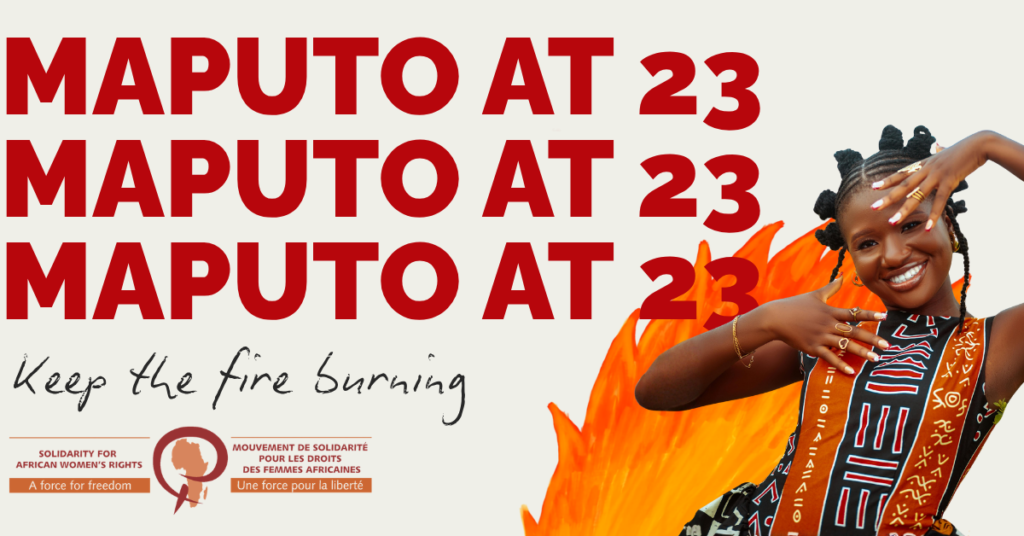
Today, 11 July 2026, marks 23 years since African governments made a promise to the women and girls of this continent. On this day in 2003, the African Union adopted the Maputo Protocol, the most comprehensive and progressive legal instrument for women’s human rights in the world. Twenty-three years on, the SOAWR Coalition and its 77 member organisations are here to say: the flame is still burning, and we intend to keep it that way.
The Maputo Protocol was born from African women’s recognition that existing international frameworks, including CEDAW, did not fully speak to their lived realities. It was conceived by African women, for African women, to fill the gaps that global conventions left behind. It was fought for, argued for, and dreamed into existence by advocates, lawyers, activists and survivors across the continent. Its provisions on health, education, freedom from violence, economic rights and political participation remain as radical and as necessary as they were the day they were written. In many countries, they have changed laws, shifted policies and saved lives. That is cause for real celebration.
But celebration without accountability is not our style. Nine African Union member states have still not ratified the Maputo Protocol, and millions of women and girls remain outside the protection of its guarantees. Among the 46 states that have ratified, implementation is uneven and progress is fragile. We are also living through a period of deliberate, organised backlash against gender equality, one that seeks to roll back the rights that women and girls have spent decades winning. Funding for women’s rights organisations is shrinking. Civic space is closing. The obstacles are real.
And still, we organise. Still, the fire burns.
The Maputo Protocol is not just a document. It is a beacon, the most comprehensive women’s rights treaty in the world; Africa’s own guarantee for its women and girls. No backlash or attempts to rewrite its history can erase it. What is required now is that every African government that has ratified moves urgently from paper commitment to lived reality: in health clinics, courtrooms, schools, fields and parliaments. We call on states maintaining reservations to lift them in line with the new AU Advocacy Framework, and on the 9 remaining states to ratify without further delay.
To our members across the continent, to our partners, and to every woman and girl who carries this flame in her community: thank you. You are why the fire does not go out.
Keep the fire burning. 🔥
Want to go deeper? In the finale of Series 2 of our All Things Maputo Protocol podcast, we explore the backlash against women’s rights and what it means for the Protocol’s future. Listen/watch here:
Find Out More
🔥 Read the Maputo Protocol, available in 13 languages.
🔥 Has your country ratified? Check the Protocol Watch
🔥 Maputo Protocol Unpacked, a toolkit for young change-makers.
🔥 20 Years of the Maputo Protocol, where are we now? Report
🔥 Listen to the All Things Maputo Protocol Podcast
🔥 Find out more about the SOAWR Coalition
Join the campaign: #MaputoAt23 #KeepTheFireBurning
@soawr.coalition What is the Maputo Protocol and how does it relate to you? Get started with this crash course and find out more at bit.ly/YoungAfricanChangeMakers #maputoprotocol #africanwomensrights #africanactivists #africanchangemakers #fyp ♬ Chill and gentle lo-fi/10 minutes(1455687) - nightbird_bgm